What is wheel offset?
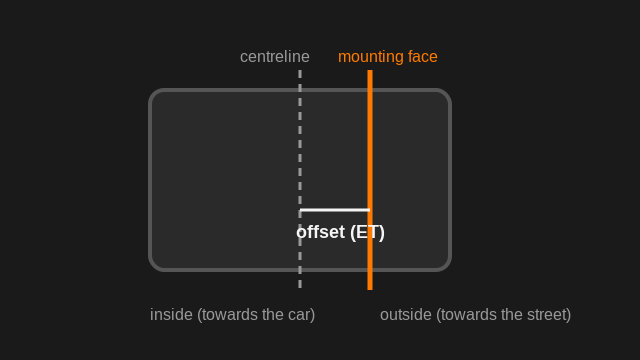
Offset (ET) is the distance between the wheel's mounting surface and its centreline. It determines how far the wheel sits inside or outside the fender.
Written by WheelStop's fitment team, cross-checked against Indian vehicle specs. Last updated .
What are positive, negative and zero offset?
Positive offset (commonly ET35 to ET50) places the wheel's mounting face closer to the outside of the wheel, pulling the wheel inward toward the suspension — this is the norm on modern front-wheel-drive hatchbacks and sedans sold in India. Negative offset pushes the mounting face inward, so the wheel sits further out toward the fender for a wider stance, common on trucks and some performance builds. Zero offset puts the mounting face exactly on the wheel's centreline. The offset number is stamped on the back of the wheel, usually as "ET" followed by the millimetre value.
Why does offset matter?
Too much positive offset — a wheel that sits further in than stock — can push the tyre into the strut, control arm, or brake caliper, especially on full steering lock or when the suspension compresses over a speed bump. Too little offset, or negative offset outside your car's range, makes the wheel and tyre sit proud of the fender — it looks aggressive but scrubs the arch liner on bumps. Staying inside your vehicle's stock offset range, usually a window of roughly ±5 to ±10mm from factory, avoids both problems without needing spacers or fender work.
How do I check offset before buying?
Use WheelStop's PCD checker to see the stock offset range for your exact make and model before browsing listings — it's pulled from the same fitment data as our vehicle pages, not a generic estimate. When a listing doesn't state offset, ask the seller directly; a wheel with the right PCD and size but an unstated offset is a common reason buyers report rubbing after a swap. If you're matching a specific look rather than staying stock, compare against WheelStop listings for the same make and model to see what offset other owners of your exact car are actually running.
Can spacers fix the wrong offset?
Wheel spacers push the wheel outward, effectively lowering its offset — useful for correcting a wheel that's slightly too far inward, or for achieving a wider stance without changing wheels. But spacers add stress to wheel bearings and lug studs, and anything beyond a thin 5–10mm spacer usually needs longer wheel studs to keep enough thread engagement for the lug nuts. Treat spacers as a fine-tuning tool, not a fix for a wheel that's grossly the wrong offset — if you need more than about 15mm of correction, the wheel probably isn't right for your car.
Where is offset marked on a wheel?
Most alloy wheels stamp their key numbers into the inner barrel or spoke back: diameter and width (e.g. "17x7.5J"), PCD, and offset ("ET45" or "OFFSET 45"). If a seller's photos don't show this clearly, ask for a close-up of the barrel stamp before buying — it's the fastest way to confirm the real spec against the listing description, since descriptions are sometimes copied from a similar-looking wheel rather than measured directly. Combined with a PCD gauge check on pickup, this is the standard way experienced buyers verify a used wheel actually matches what was advertised.